Reflections by Day

April 2026
Su Mo Tu We Th Fr Sa
29 30 31 1 2 3 4
5 6 7 8 9 10 11
12 13 14 15 16 17 18
19 20 21 22 23 24 25
26 27 28 29 30 1 2

Audio/Video Resources

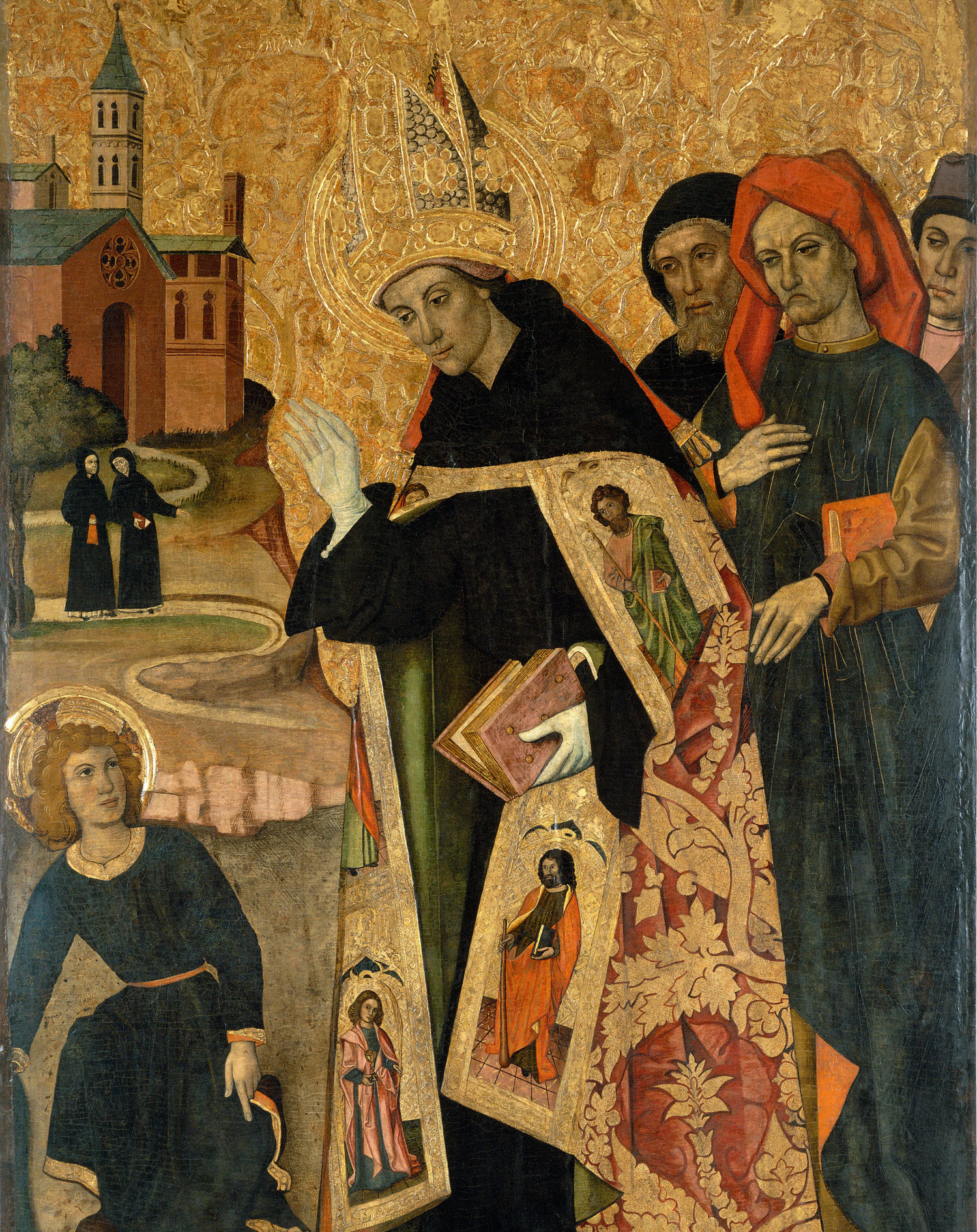
https://upload.wikimedia.org/wikipedia/commons/2/29/Verg%C3%B3s_Group_-_Saint_Augustine_Meditates_on_the_Trinity_when_the_Child_Jesus_Appears_before_him_-_Google_Art_Project.jpg

On this feast of the Most Holy Body and Blood of Christ, let us ask St. Augustine, the Doctor of grace, to intercede for us that we may come to understand the supreme gift and act of love of our Lord present in the Eucharist:

Augustine on the Nature of the Sacrament of the Eucharist

Sermon 272

“What you see is simply bread and a cup - this is the information your eyes report. But your faith demands far subtler insight: the bread is Christ's body, the cup is Christ's blood. Faith can grasp the fundamentals quickly, succinctly, yet it hungers for a fuller account of the matter… My friends, these realities are called sacraments because in them one thing is seen, while another is grasped. What is seen is a mere physical likeness; what is grasped bears spiritual fruit…

But what role does the bread play? We have no theory of our own to propose here; listen, instead, to what Paul says about this sacrament: "The bread is one, and we, though many, are one body" (1 Cor. 10.17)... "One bread," he says. What is this one bread? Is it not the "one body," formed from many? Remember: bread does not come from a single grain, but from many… When you were baptized, you were "leavened." When you received the fire of the Holy Spirit, you were "baked." Be what you see; receive what you are. This is what Paul is saying about the bread.

So too, what we are to understand about the cup is similar and requires little explanation. In the visible object of bread, many grains are gathered into one just as the faithful form "a single heart and mind in God" (Acts 4.32). And thus it is with the wine. Remember, friends, how wine is made. Individual grapes hang together in a bunch, but the juice from them all is mingled to become a single brew. This is the image chosen by Christ our Lord to show how, at his own table, the mystery of our unity and peace is solemnly consecrated...

So let us give God our sincere and deepest gratitude, and, as far as human weakness will permit, let us turn to the Lord with pure hearts. With all our strength, let us seek God's singular mercy, for then the Divine Goodness will surely hear our prayers. God's power will drive the Evil One from our acts and thoughts; it will deepen our faith, govern our minds, grant us holy thoughts, and lead us, finally, to share the divine happiness through God's own son, Jesus Christ. Amen!”

Tuesday, February 11, 2014 marks the 156th anniversary of the first apparition of Our Lady at Lourdes, a small village in southern France.  Young Bernadette Soubirous was waiting for her companions to return from their search for firewood.  She heard a frightening sound, and looking toward the grotto of Massabielle, she saw a beautiful young lady at the mouth of the grotto. The lady looked at Bernadette, smiled and motioned that she should draw closer.  Bernadette complied and, kneeling and waiting for the lady to begin, she prayed the rosary with her.  When the rosary was finished (the lady prayed all but the Hail Mary’s), the lady, and the accompanying golden cloud, retired to the interior of the cave. Thus began a series of eighteen apparitions in which Bernadette received instructions from Our Lady who revealed herself as “The Immaculate Conception” (The dogma had already been declared by Pope Pius IX on December 8, 1854).

Even as I write this, I recall my first visit to Lourdes in 1958: the all-night vigil, working at the baths, the joy and peace even on the part of those who came for healing.  Let us never forget the message of Lourdes: “pray for sinners.”  This has been the constant call in all the ensuing apparitions of Mary over the last 156 years.  She has urged us to pray the Rosary for this world, thus joining her in the most profound form of almsgiving we can offer.

Following last week’s post, here are some practical aspects (they are not necessarily ‘steps’) to guide you as you read Scripture:

I. Reading: Spending Time with the Biblical Text

A. Read to become familiar (write out the text)

B. Read to Learn the Teachings of the Faith

Luke 24:27-46 27 “And beginning with Moses and all the prophets, he interpreted to them in all the scriptures the things concerning himself… And their eyes were opened and they recognized him; and he vanished out of their sight.  32 They said to each other, ‘Did not our hearts burn within us while he talked to us on the road, while he opened to us the scriptures?’ …  45 Then he opened their minds to understand the scriptures,  46 and said to them, ‘Thus it is written, that the Christ should suffer and on the third day rise from the dead.’”

C. Read to hear the Lord

“By this revelation, therefore, the invisible God (see Col 1:15; 1Tim 1:17), out of the immensity of his love, speaks to men and women as friends (see Ex 33:11; Jn 15:14-15) and associates with them (see Bar 3:38) that he might invite them to communion with himself and receive them into his company” (DV, 2).

II. Meditating: Applying Your Mind to What the Text is Talking About

A. When an incident is being recounted:

Search out its “interior reality,” its mystery
Place yourself there (Martha and Mary; the healing of a blind man)
Use the Rosary
Look at a good commentary

B. When a teaching is being given (example: the Letters in the New Testament):

Seek to understand the words (example: use a concordance, the Catechism, a Bible Dictionary, etc.)
Again, use a commentary

C. Move with the Psalms

III. Prayer: Speak to the Lord About What Is On Your Mind From the Reading

A. Beg for understanding (and then wait in silence for a while)

B. Ask the Lord to show you the obstacles in you preventing you from understanding

C. Let the Holy Spirit bring what your mind has learned (and ultimately your mind itself) into your heart

D. Speak to Him of your longing

IV. Contemplation: Enjoy the Lord’s Company and Be Changed by His Presence

“Reading seeks for the sweetness of a blessed life, meditation perceives it, prayer asks for it, contemplation tastes it. Reading, as it were, puts food whole into the mouth, meditation chews it and breaks it up, prayer extracts its flavor, contemplation is the sweetness itself which gladdens and refreshes. Reading works on the outside, meditation on the inner core, prayer asks for what we long for, contemplation gives us delight in the sweetness we have found” (Guigo the Carthusian).

Questions

  1. What is your favorite way of reading Scripture?
  2. Name three recent occasions when you have been blessed by reading Scripture.
  3. What practical actions do you take that could be classed as “meditation”?
  4. Can you get at least three hours a week for Lectio Divina?

May you be blessed by the Scriptures for the upcoming Sundays as we approach the end of the church year with reflections by Fr. Francis Martin.

* Reflections are also available as YouTube playlists for the current season and the corresponding reflections.


1st Sunday of Advent Advent (Cycle C)    
Reflection The World Listen Video
First Reading
Psalm
Jeremiah 33:14-16
Psalm 25:4-14*
Listen Video
Second Reading 1 Thessalonians 3:12-4:2 Listen Video
Gospel Luke 21:25-28,34-36 Listen Video
2nd Sunday of Advent Advent (Cycle C)    
Reflection Encounter with Jesus Listen Video
First Reading
Psalm
Baruch 5:1-9
Psalm 125:1-6
Listen Video
Second Reading Philippians 1:4-6,8-11 Listen Video
Gospel Luke 3:1-6 Listen Video


To copy the audio or video to your computer, right-click on the link, choose Save As... or a similar option and follow the prompts.

More reflections for Advent and Christmas, Cycle C

Please donate TODAY to keep this site active!

Tell us if something appears out of date, missing, or broken.

To contribute content, submit a video sample and bio.